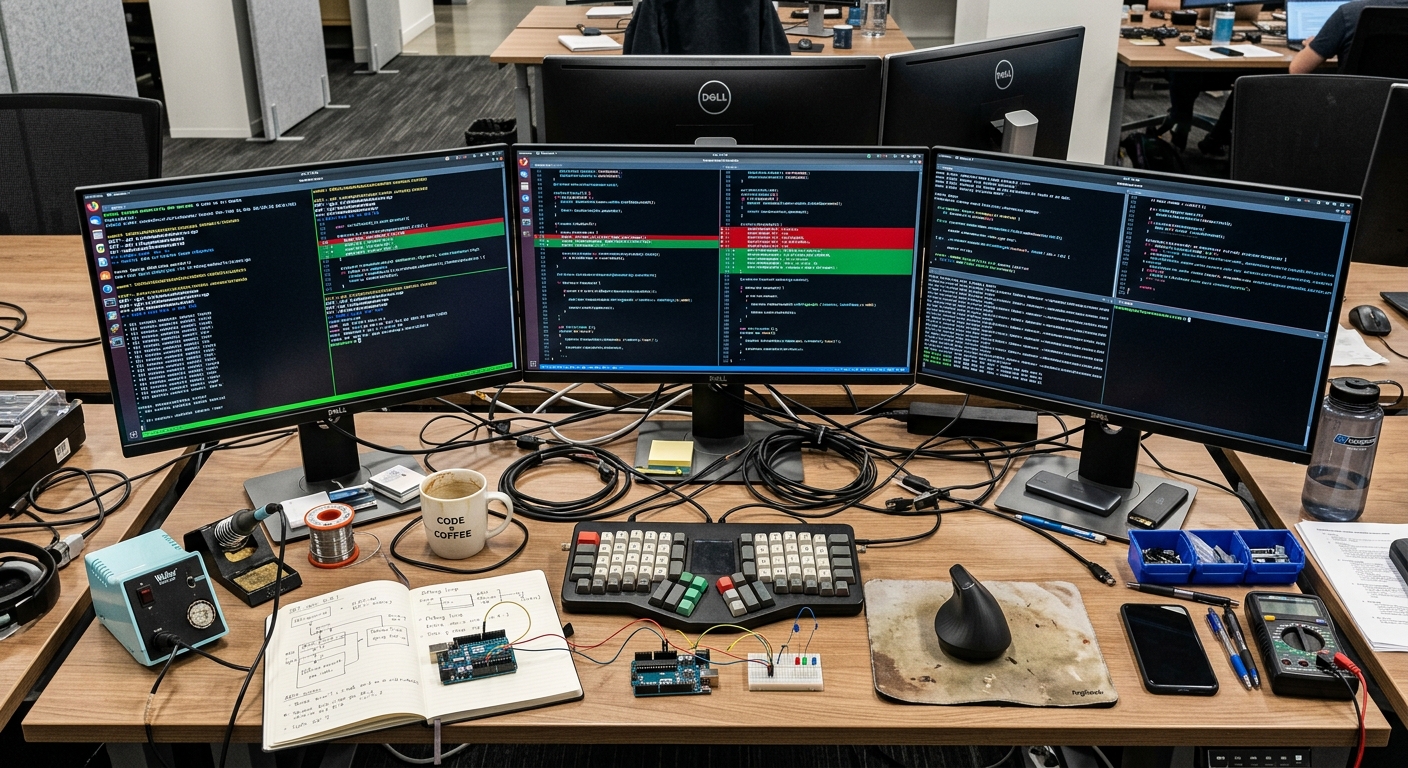
Last month, I attempted to migrate a legacy authentication module into a separate microservice. The code was five years old, filled with circular dependencies and shadowed variables that made any change feel like a pending incident. I used this as a benchmark to see how the current crop of AI tools handles a codebase exceeding 1.2 million lines of code. If you expect a magic tool that lets you ship without a rollback, you will be disappointed. These tools are assistants, not replacements for a senior reviewer.
# Example of the circular dependency that broke the initial refactor
# auth.ts -> session.ts -> user.ts -> auth.ts
import { validateSession } from './session';
export const authenticate = (token: string) => validateSession(token);
I tested Cursor, the current IDE standard, against the new Claude Code CLI. I also looked at Devin for more autonomous tasks. The results showed that while both tools can read code, their ability to map undocumented internal APIs in a massive monorepo varies significantly based on how they handle context windows.
What you will have at the end
By following this guide, you will have a configured environment for both Cursor and Claude Code that is optimized for large repositories. You will also have a set of benchmarks to help you decide which tool to use for specific tasks like multi-file refactoring or investigating a flaky test suite. You will understand the unit economics of each, similar to the breakdowns we see in AI for client onboarding.
Prerequisites
Before you start, ensure you have the following installed and configured:
- A codebase exceeding 500,000 lines of code. Smaller repos do not trigger the same indexing failures.
- Node.js 18 or higher for the Claude Code CLI.
- A Cursor Pro or Business account. The free tier limits are too low for meaningful indexing of large systems.
- Anthropic API keys with sufficient credits for Claude Code. Unlike Cursor, Claude Code consumes your own API tokens directly.
- Access to ChatGPT or Grammarly for basic documentation cleanup, though they will not be our primary drivers here.

Step 1: Indexing and resource consumption
Cursor relies on a local index that it syncs with its own servers. For a repository with 1.2 million lines of code, the initial indexing took 14 minutes on a M3 Max Macbook Pro. During this time, the Cursor process hovered around 4GB of RAM. The advantage here is that once the index is built, symbol search and RAG (Retrieval-Augmented Generation) are relatively fast.
Claude Code takes a different approach. It is a CLI tool that does not maintain a massive permanent local index in the same way. Instead, it uses a combination of file system crawling and prompt caching. When I ran claude in the root of the monorepo, it spent about 2 minutes scanning the structure before it was ready for queries.
The tradeoff is clear. Cursor is better for visual navigation and "chatting" with your files. Claude Code is better for an edit-compile-test loop. If you need to find where a specific backpressure mechanism is implemented across ten services, Cursor's UI makes it easier to browse the results. However, Claude Code's agentic nature allows it to run grep, find, and ls commands directly in your terminal, which often finds shadowed variables that RAG might miss.
Step 2: Executing a multi-file architectural migration
I tasked both tools with the same goal: "Extract the session validation logic from the auth service and move it to a new shared library, updating all internal imports."
Cursor's Composer mode attempted to write the files one by one. It succeeded on the first three files but hit a context limit on the fourth. Because Cursor hides some of the token management, it is hard to tell when the model starts losing older parts of the conversation. I had to manually point it back to the first file to fix a regression it introduced in the exports.
Claude Code handled the migration using an agentic loop. It wrote a plan, then executed shell commands to create directories and move files. Because it uses Claude 3.5 Sonnet with a massive context window and prompt caching, it retained the architectural map better than Cursor. It correctly identified a circular dependency between session.ts and user.ts that Cursor ignored.
| Feature | Cursor (IDE) | Claude Code (CLI) |
|---|---|---|
| Indexing Speed | Slow (Initial) / Fast (Subsequent) | Fast (On-demand) |
| Context Management | Managed RAG | Agentic File Access |
| Multi-file Editing | Visual Diffs | CLI-based Overwrites |
| Cost Structure | Fixed Monthly Fee | Pay-per-token |
| Terminal Access | Integrated | Native |
For more on how these tools compare in a professional setting, see our senior reality check.

Step 3: Measuring token efficiency and cost
This is where the math gets messy. Cursor Pro costs $20 per month and gives you a set amount of "fast" requests. For a large codebase, you will burn through these quickly. Once you are on "slow" requests, the latency becomes a productivity killer.
Claude Code uses your Anthropic API key. For the migration task mentioned in Step 2, I spent approximately $4.12 in tokens. This included the initial file scans, the plan generation, and the actual file writes. While $4.12 sounds cheap for a refactor, doing this ten times a day adds up. You are paying for every single byte of context the CLI sends to the model. In a large repo, if you are not careful with your .claudeignore file, you will pay for the model to read your node_modules or build artifacts.
For enterprise scale, the cost of Claude Code is more transparent but potentially higher than Cursor's flat fee. If you are managing a team of 50 engineers, the predictability of Cursor's pricing is an advantage, even if the tool is less agentic.
Troubleshooting
If you find that Cursor is giving you hallucinated API calls, check your .cursorrules file. Often, the indexer picks up outdated documentation or test mocks instead of the actual implementation. You can force a re-index, but it is better to explicitly exclude directories that contain legacy garbage.
If Claude Code is failing to find files, ensure you are running it from the root of your project. If it gets stuck in a loop trying to fix a linter error, use Ctrl+C to interrupt it. It does not have a perfect success rate, and it will sometimes attempt to fix a flaky test by simply deleting the test case. Always review the diffs before you commit.
Next steps
To truly test these tools on your own system, I recommend the following test:
- Pick a complex, multi-service interaction that is currently undocumented.
- Ask both tools to generate a sequence diagram of the data flow.
- Compare the output against your observability platform (like Datadog or Honeycomb).
In my test, Claude Code was 20% more accurate in identifying the specific middleware where backpressure was being applied. Cursor tended to generalize based on common patterns it saw in the codebase, missing the custom implementation we had built.
Both tools are better than writing everything by hand, but neither replaces the need for a thorough post-mortem when things go wrong. For those looking for even more autonomy, exploring Devin might be the next logical move for handling entire PRs without supervision. If you are focused on the business side of automation, you might find our breakdown on how to automate client reporting useful for understanding the broader impact of AI on engineering velocity.