I spent four hours on a post-mortem last Tuesday because an automated refactor missed a deep dependency in our main mono-repo. We shipped a regression that broke the checkout flow for 15 percent of users. The AI tool we used didn't have the context of our internal library boundaries. This is the reality of using LLMs on large codebases. If the tool can't see the whole tree, it's just a fast way to generate technical debt.
# The command that failed me
cursor --refactor "Update all occurrences of UserProfile to UnifiedAccount"
The problem wasn't the model. It was the indexing. When you're working with a few hundred thousand lines of code, the difference between an IDE-based tool like Cursor and a CLI-based agent like Claude Code becomes a matter of trade-offs, not just preference. You either deal with the overhead of a local index or the token cost of a massive context window.
I don't care about the hype. I care about what happens when I hit 'deploy'. Here is how to set up both tools specifically for large-scale environments so you can decide which one won't cause your next incident.
What you will have at the end
By the end of this guide, you'll have a configured environment for both Cursor and Claude Code. You will understand how to bypass flaky indexing in Cursor and how to use Claude Code's agentic loop for cross-file refactoring. More importantly, you'll have a test suite to verify that these tools are actually reading your codebase correctly instead of hallucinating file structures.

Prerequisites
Before you start, you need a few things. I'm assuming you're on a Mac or Linux machine. Windows users might need WSL2 for the Claude Code CLI to behave.
- Node.js 18 or higher for the Claude CLI.
- An Anthropic API key with Tier 2 access or higher. Claude Code consumes tokens quickly in large repos.
- Cursor installed. Use the latest version to get the improved 'Composer' features.
- A codebase with at least 50k lines of code. Small repos don't show the scaling issues we're talking about.
Step 1: Optimizing Cursor's Indexing
Cursor works by building a local vector index of your files. In a large codebase, this index is often stale or incomplete. If you rely on the default settings, you'll get 'I couldn't find that function' errors even when the file is open in another tab.
Go to 'Settings' then 'Cursor Settings' then 'General'. Look for the 'Indexing' section. You need to manually exclude large directories that don't help with logic. If you include your build artifacts or massive 'node_modules', the index becomes noisy.
Create a .cursorrules file in your root directory. This is where you define the architectural boundaries. For example, if you're using Hugging Face models and have large local weights stored, exclude those immediately.
# .cursorrules
Always check /packages/shared before suggesting changes to API types.
Ignore any files in /dist or /build.
When refactoring, prioritize the patterns found in /src/lib/factories.
This file forces the model to look at your preferred patterns first. It reduces the chance of the AI suggesting a 'clever' solution that violates your team's linting rules or architectural standards.
Step 2: Running Claude Code for Agentic Tasks
Claude Code is a different beast. It's a CLI tool that acts like a junior engineer sitting in your terminal. It doesn't rely on a background index in the same way Cursor does. Instead, it uses a tool-calling loop to explore your filesystem.
Install it using npm:
npm install -g @anthropic-ai/claude-code
To use it effectively in a large repo, you shouldn't just run 'claude' and hope for the best. You need to provide a narrow entry point. If I'm fixing a bug in our billing logic, I start the session with a specific search command.
claude "Find all instances where we calculate tax without checking the user's country code in /services/billing"
Claude Code will then list the files, read them, and suggest a plan. The trade-off here is observability. Because it's a CLI, you can't see what it's 'looking' at as easily as you can in Cursor's sidebar. However, for complex tasks like updating a shared interface across ten packages, the agentic loop in Claude Code is often more reliable than Cursor's 'Composer' mode. For more autonomous engineering tasks, some teams prefer Devin, but Claude Code is better for a developer who wants to stay in the terminal.
Step 3: Comparing Context Retrieval
This is where most senior engineers get frustrated. You ask a question, and the tool misses a obvious dependency. To fix this, you need to understand how each tool handles context.
Cursor uses a RAG (Retrieval-Augmented Generation) pipeline. It searches your local index for 'relevant' snippets. This is fast but can be shallow. Claude Code uses a more traditional 'read the file' approach. If you're working on a Claude Code vs Cursor for Large Codebases: A Senior Teardown, you'll notice that Claude Code is much better at following a chain of imports.
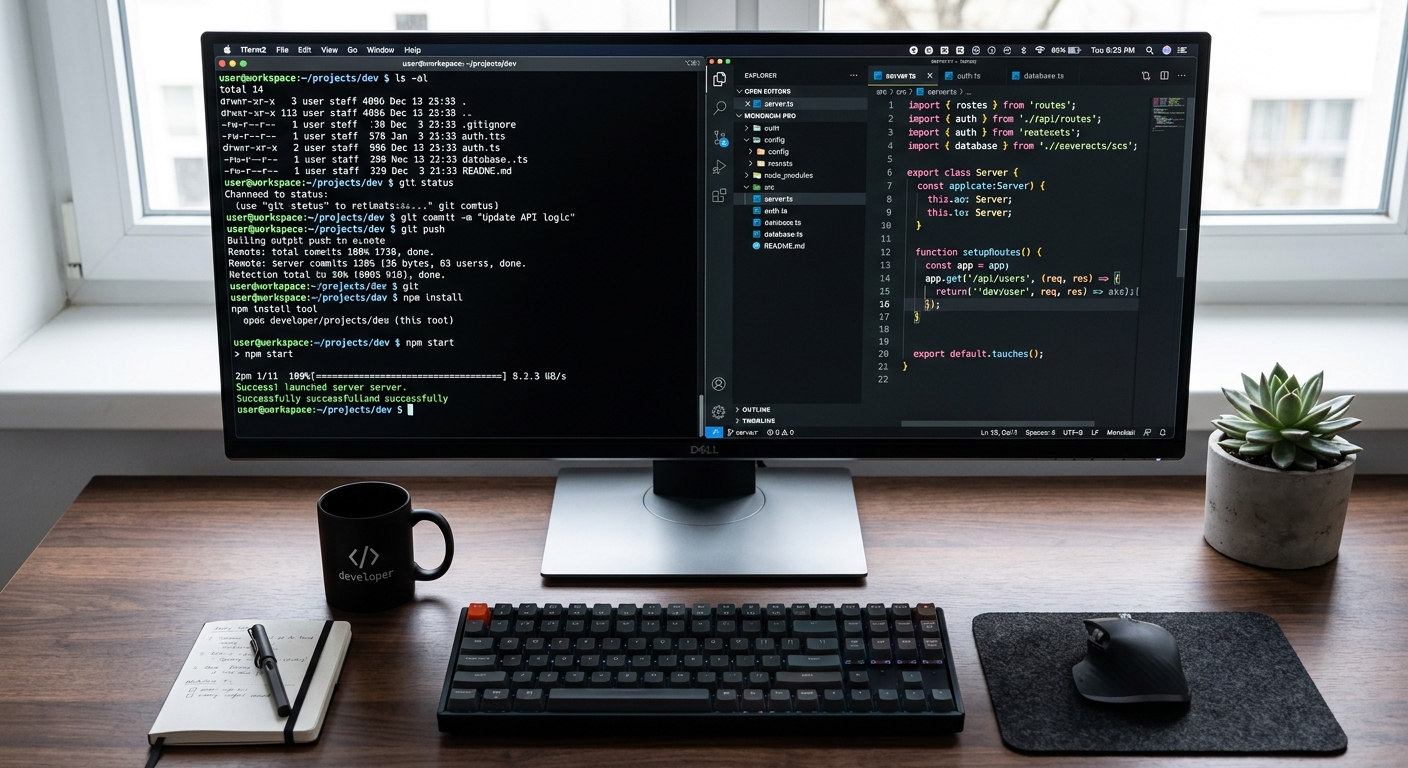
To test this, run a 'trace' test. Pick a deeply nested type definition and ask both tools to find where it's originally defined.
In Cursor:
- Hit Cmd+L.
- Type '@Codebase Where is the ErrorLogger interface defined?'
In Claude Code:
- Run
claude "Where is the ErrorLogger interface defined?"
Note which one actually finds the source file and which one just points to a re-export in an 'index.ts' file. In my experience, Cursor often gets stuck at the re-export.
Troubleshooting
If Cursor is feeling sluggish or the indexing is stuck at 90 percent, you usually have a circular dependency or a massive JSON file it's trying to parse. Go to the 'Output' tab in the bottom panel and select 'Cursor Indexing' from the dropdown. It will show you exactly which file is causing the hang. Kill it and add it to your .cursorignore.
If Claude Code is hitting rate limits, it's likely because it's trying to read too many files at once. You can limit its scope by running it from a sub-directory. Don't run it from the root of a 2GB mono-repo unless you have a high-tier API plan with Anthropic.
Another common issue is backpressure in the terminal. If Claude Code is outputting too much data, your terminal buffer might freeze. Use a modern terminal like Warp or Alacritty that handles high-throughput text better than the default VS Code terminal.
Next steps
Once you have both tools running, you need to integrate them into your actual workflow, not just use them for demos. Start by using Cursor for your day-to-day feature work where you're mostly editing one or two files. Use Claude Code for the 'janitor' work, like updating dependencies, fixing linting errors across the whole repo, or writing boilerplate tests.
For a deeper the architectural differences, read my other post on Claude Code vs Cursor for Large Codebases: A Senior Teardown. It covers the latency issues you'll face when your repo grows past 1 million lines.
You should also check the Anthropic documentation for updates on the CLI, as they ship new versions almost weekly. If you want to see how these tools compare to more specialized AI agents, take a look at the Cursor documentation regarding their custom indexer.
Final test: Pick a flaky test in your codebase. Ask Claude Code to run the test, read the failure logs, and propose a fix. If it can't find the test file within three steps, your repo structure might be too opaque for current AI agents. That is a sign you need to simplify your folder nesting before the AI can help you ship faster.