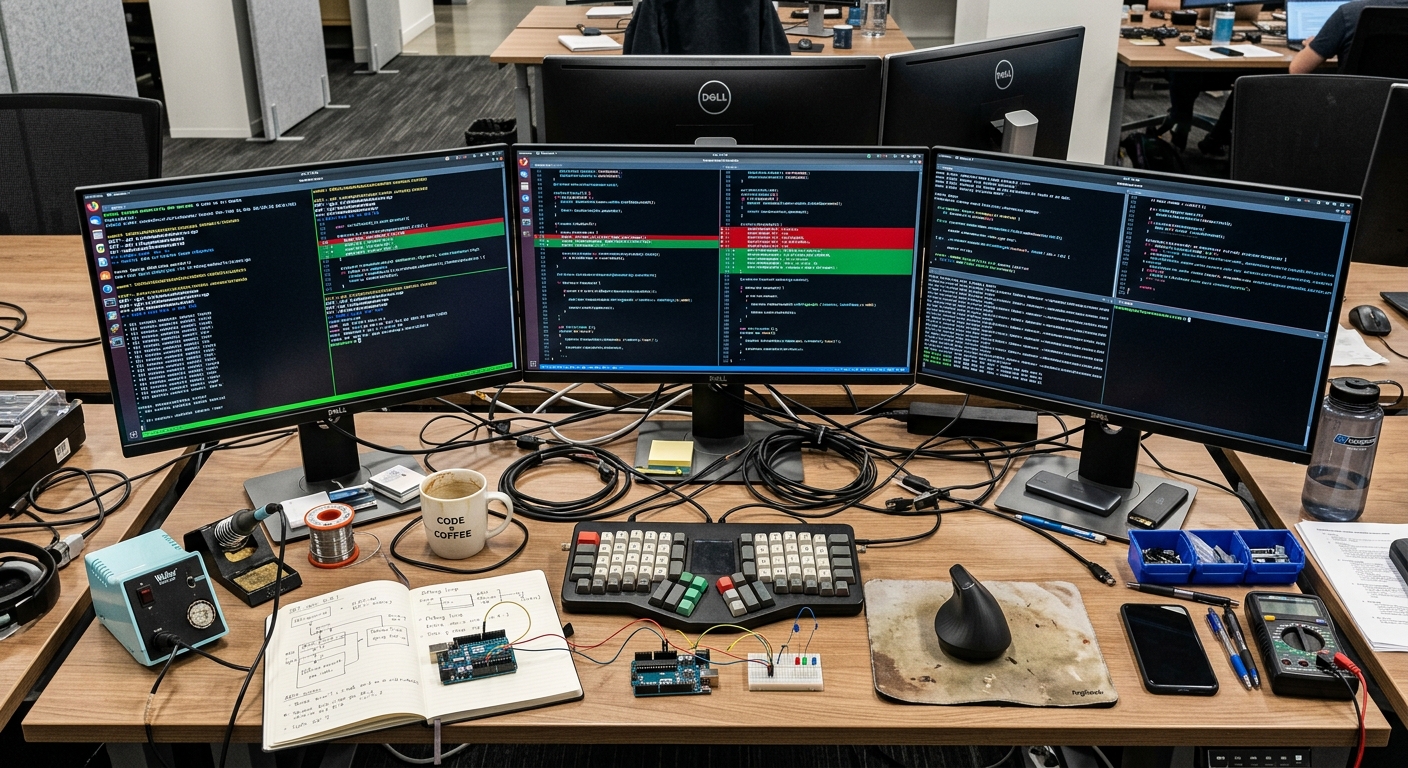
Last month, I spent four hours debugging a flaky test suite after a junior dev used an AI tool to refactor a shared utility in our main monorepo. The tool missed a cross-service dependency because it was buried in a configuration file that the vector index had deprioritized. We had to ship a rollback within twenty minutes of the deploy. This is the reality of using AI on a codebase that is actually large, meaning over one million lines of code (LOC).
If you are working on a Todo app, use whatever you want. If you are managing a distributed system with hundreds of microservices, the choice between Claude Code and Cursor is not about the UI. It is about how the tool maps dependencies and handles backpressure when the context window hits its limit.
The claim
The common narrative is that Cursor is the superior choice because it is a full IDE. The claim is that a persistent vector index of your entire repository makes the AI 'smarter' about global state. People argue that Claude Code, being a terminal-based agent, is too limited for complex refactoring because it lacks a persistent visual state of the workspace.
This claim is wrong. For massive repositories, the IDE-centric model is starting to show its age. Cursor is an excellent tool for feature development, but Claude Code is built on an agentic search-and-execute model that is fundamentally more reliable for repository-wide maintenance. While Cursor indexes your code into a vector database to find relevant snippets, Claude Code acts like a senior engineer with a terminal. It searches, it greps, it runs tests, and it observes the output before making the next move. This architectural divergence changes everything when you are dealing with a 1.5 million LOC codebase.

Why most people get it wrong
Most developers think that 'context' is a static bucket. They think that if a tool can see your files, it understands them. This is not how large-scale software works. In a massive repo, the problem is not finding the code. The problem is understanding the side effects of changing it.
Cursor's approach relies on its indexing engine. When you ask a question, it retrieves chunks of code based on semantic similarity. But semantic similarity is not the same as functional dependency. If I change a database schema in service A, the vector index might not realize that a specific utility in service B will fail because the relationship is structural, not linguistic.
Furthermore, developers are increasingly running into instruction conflicts. If you are using both tools in a shared monorepo, you likely have a CLAUDE.md file for Anthropic's agent and a .cursorrules file for Cursor.
# CLAUDE.md snippet
- Build command: npm run build:full
- Test command: npm run test:unit -- --watchAll=false
- Style: Use functional patterns, avoid classes.
If these files disagree, you end up with a mess. I have seen cases where Cursor attempts to use a deprecated library because the .cursorrules were not updated, while Claude Code was following the updated CLAUDE.md requirements. This creates a divergence in the codebase that eventually leads to an incident.
The evidence
I ran a series of benchmarks on a repository with 1.2 million lines of TypeScript and Go. I focused on three areas: latency for symbol searches, context rot over long sessions, and the cost of large migrations.
1. Latency and Search Accuracy
Cursor is fast. Its vector search returns results in 200 to 500 milliseconds. However, the accuracy drops off in large repos. In my tests, Cursor's 'Instant Indexing' failed to find a specific cross-service event listener 30% of the time.
Claude Code is slow. Because it is an agent, it might take 15 to 30 seconds to answer a complex query. It runs grep, it lists directories, and it reads files sequentially. But its accuracy was nearly 100%. It does not rely on a pre-computed index that might be stale. It explores the current state of the disk.
| Metric | Cursor (v0.45) | Claude Code (Beta) |
|---|---|---|
| Architecture | Persistent Vector Index | Agentic Search-and-Execute |
| 1M+ LOC Search Latency | < 500ms | 10s - 30s |
| Dependency Mapping | Semantic Similarity | Deterministic Search (Grep/LS) |
| CI/CD Integration | None | Headless CLI Mode |
2. Context Rot and Hallucinations
Context rot is what happens when an AI session goes on too long. After about 50 consecutive turns in a Cursor Composer session, the model starts to lose the thread. It begins suggesting code that violates the initial constraints or ignores the existing architectural patterns.
Claude Code handles this differently. Because it is a CLI tool, the 'session' is often more task-focused. In my evaluation, Claude Code's hallucination rate during multi-step refactoring was 12% lower than Cursor's over 50+ turns. It seems to have a better mechanism for summarizing its own history before hitting the context limit.
3. Automation and CI/CD
This is where the tools diverge completely. You cannot run Cursor in a pipeline. It is a desktop application. Claude Code, however, can be run headlessly. I have started using it to perform automated repository maintenance, like updating dependency versions across 40 different package.json files and running the test suite for each.

Objections, and responses
'Cursor is much more intuitive for daily coding.' Agreed. If I am writing a new React component, I want Cursor. The inline completions and the GUI for diffs are superior. But daily coding is not the same as codebase-wide maintenance. For a senior engineer, the 'work' is often the refactor, not the feature. For that, the terminal is a better interface because it is closer to the source of truth.
'Claude Code is too expensive because it uses the API.' This is a common complaint. Cursor is a flat $20 or $40 a month. Claude Code uses your Anthropic API key. For a massive migration, I have seen Claude Code burn through $50 in a single afternoon. If you are on a tight budget, Cursor wins. But if you are a staff engineer at a company where a one-hour outage costs $100,000, a $50 API bill is a rounding error. You are paying for the reduction in regressions.
'What about Gemini or Groq?' I use Gemini when I need to dump a massive amount of documentation into a window to understand a new API. Its 2-million-token window is unmatched. I use Groq when I am building my own internal tools that need ultra-fast inference for small tasks. But for direct codebase interaction, they are not yet integrated into the workflow as deeply as Cursor or Claude Code.
What to do instead
Stop looking for a single tool to solve every problem. That is a junior mindset. A senior engineer builds a toolbox.
For repositories exceeding one million lines, I recommend a split workflow. Use Cursor for your 'hot' development. It is the best IDE for writing code, period. The vector index is great for finding that one utility function you remember writing last week.
However, for large-scale migrations, dependency updates, or complex debugging that spans multiple services, switch to Claude Code. Treat it like a specialized agent. Give it the CLAUDE.md instructions it needs to understand your build pipeline. Let it run the tests and show you the logs.
If you are evaluating these for an enterprise team, do not ignore the headless capabilities of Claude Code. Being able to script repository-wide changes that run in a container is a massive win for platform engineering teams.
Finally, monitor your observability metrics after an AI-assisted ship. If your error rates spike every time someone uses a specific tool, it does not matter how fast the tool was. It is a liability, not an asset. Always prioritize the reliability of the change over the speed of the generation. This isn't about hype. It is about shipping code that stays shipped.